
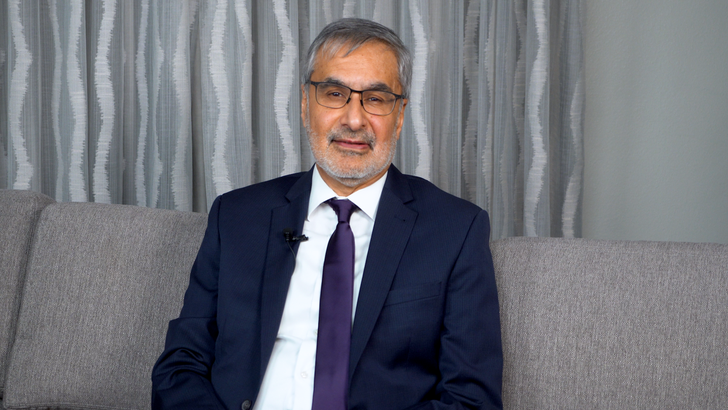
Dr. Mike Sharma reviews the primary results from the landmark phase 3 OCEANIC-STROKE trial, assessing asundexian in patients with acute non-cardioembolic stroke or high-risk TIA. He highlights the trial’s implications for secondary stroke prevention and discusses stroke recurrence rates, bleeding outcomes, and what these data could mean for clinical decision-making.
OCEANIC-STROKE Results: Asundexian for Secondary Stroke Prevention After Acute Non-Cardioembolic Stroke or High-Risk TIA

Transcript
OCEANIC-STROKE Results: Asundexian for Secondary Stroke Prevention After Acute Non-Cardioembolic Stroke or High-Risk TIA
closeTranscript
OCEANIC-STROKE Results: Asundexian for Secondary Stroke Prevention After Acute Non-Cardioembolic Stroke or High-Risk TIA
closeTranscript
OCEANIC-STROKE Results: Asundexian for Secondary Stroke Prevention After Acute Non-Cardioembolic Stroke or High-Risk TIA
closeAnnouncer:
Welcome to DataPulse from ISC25 on ReachMD. This activity, titled “OCEANIC-STROKE Results: Asundexian for Secondary Stroke Prevention After Acute Non-Cardioembolic Stroke or High-Risk transient ischemic attack” is provided by Medcon International.
Dr. Sharma:
Greetings from ISC 2026 here in New Orleans. I'm Dr. Mike Sharma, and I'm here with breaking results from the OCEANIC-Stroke Trial.
This is the first phase 3 study to test the safety and efficacy of asundexian, a factor XIa inhibitor for the secondary prevention of stroke after acute non-cardioembolic stroke or high-risk TIA. This was a large phase 3 randomized, double-blinded, event-controlled and placebo-controlled trial. We randomized 12,327 patients who had had a non-cardioembolic stroke or high-risk TIA within the last 72 hours and followed them until we’d attained over 900 primary events. We examined the effect of asundexian 50 mg once a day and the inhibitor of factor XIa versus placebo on top of standard antiplatelet therapy. So, patients could be on either single antiplatelet therapy or dual antiplatelet therapy at the discretion of their treating physicians when they were randomized.
The key findings were really quite impressive. There was a significant reduction in recurrent ischemic stroke with asundexian, with a hazard ratio of 0.74. The curves diverged early and continued to diverge throughout the treatment period. Most impressively, there was no increase in ISTH major bleeding versus placebo on top of antiplatelet therapy. This was quite a pleasing result and the first time we've seen an uncoupling of hemostasis and thrombosis. We examined a number of subgroups, and the effect was consistent across key subgroups, including stroke subtypes, stroke severity measured by NIHSS, age, sex, and race.
These findings are really quite impressive, and the first time in 50 years we’ve developed a new treatment for the secondary prevention of stroke, which can be started early and continued for the long term. I think this is going to fundamentally change the way we approach antithrombotic therapy for secondary prevention of non-cardioembolic stroke. We don't have to worry about hemorrhage, and we don't have to be very selective in the patients we treat.
From ISC 2026, I'm Dr. Mike Sharma, and thank you for watching.
Announcer:
Thank you for listening to this DataPulse from ISC25 on ReachMD. This activity is provided by Medcon International. Thank you for listening.
Ready to Claim Your Credits?
You have attempts to pass this post-test. Take your time and review carefully before submitting.
Good luck!
Overview
Provider(s)/Educational Partner(s)

Today’s healthcare environment is constantly evolving and advances of medical science occur at an accelerating pace. CME/CE plays an important role in the clinical environment and is an essential element of physician training, learning, and improvement, thereby importantly contributing to optimal patient care. Since 2000, MEDCON’s mission is to deliver high quality within the world of medical education by creating forums like PACE-CME, organizing live meetings, and providing online education. We aim to stimulate the review, exchange, and assimilation of key scientific findings to improve patients’ health, to raise awareness of new science underlying various disease states, and to accelerate the translation of this information into clinical practice.Commercial Support
This activity is supported by an independent educational grant from Bayer AG.
videoBeyond the Primary Endpoint: What OCEANIC-STROKE Subtype Analyses Reveal About Asundexian’s Potential
Show more
Overview
Dr. Mike Sharma reviews the primary results from the landmark phase 3 OCEANIC-STROKE trial, assessing asundexian in patients with acute non-cardioembolic stroke or high-risk TIA. He highlights the trial’s implications for secondary stroke prevention and discusses stroke recurrence rates, bleeding outcomes, and what these data could mean for clinical decision-making.
Provider(s)/Educational Partner(s)

Today’s healthcare environment is constantly evolving and advances of medical science occur at an accelerating pace. CME/CE plays an important role in the clinical environment and is an essential element of physician training, learning, and improvement, thereby importantly contributing to optimal patient care. Since 2000, MEDCON’s mission is to deliver high quality within the world of medical education by creating forums like PACE-CME, organizing live meetings, and providing online education. We aim to stimulate the review, exchange, and assimilation of key scientific findings to improve patients’ health, to raise awareness of new science underlying various disease states, and to accelerate the translation of this information into clinical practice.Commercial Support
This activity is supported by an independent educational grant from Bayer AG.
videoBeyond the Primary Endpoint: What OCEANIC-STROKE Subtype Analyses Reveal About Asundexian’s Potential
Show more
Title
Share on ReachMD
CloseProgram Chapters
Segment Chapters
Playlist:
Recommended
We’re glad to see you’re enjoying ReachMD…
but how about a more personalized experience?


